

Kumaoni food is built for cold mornings and long walks uphill. Lentils that grow at altitude, greens picked from the terrace, heavy iron kadhais, and a tempering spice called jakhiya that you won’t find in a Delhi kitchen. Most of it is cooked at home, not in restaurants. That’s the main reason tourists in Nainital go home thinking the local food is momos and Maggi.
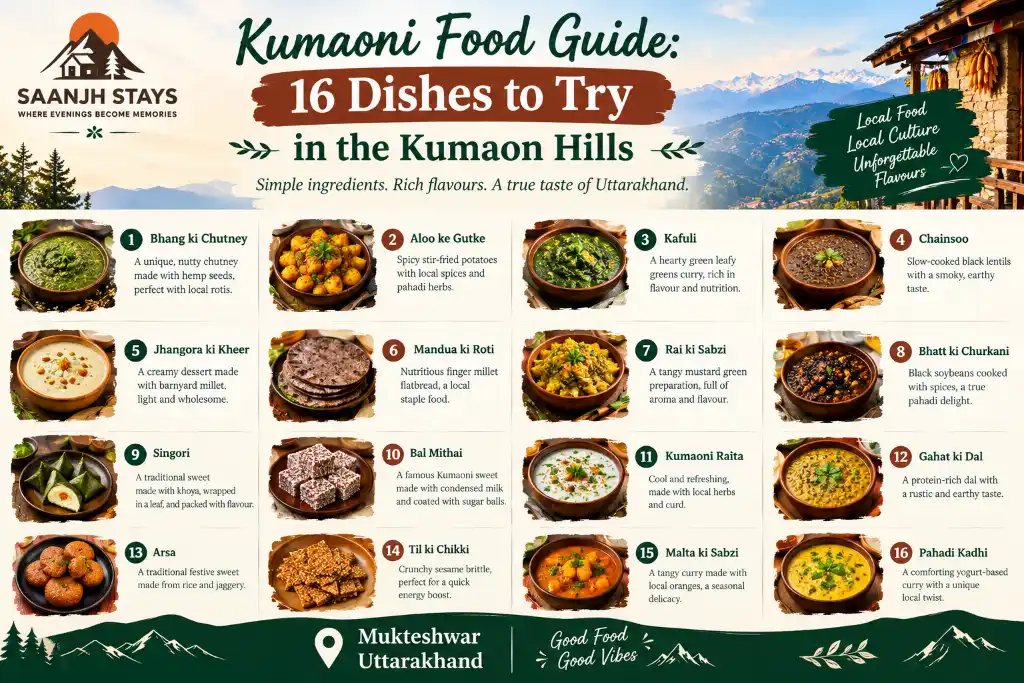
This guide lists 16 Kumaoni dishes to look for, what’s in them, and where you’re most likely to find them.
Kumaoni dishes at a glance
| Dish | Type | Main ingredient | When to try |
|---|---|---|---|
| Bhatt ki churkani | Curry | Black soybean | Year-round, best in winter |
| Bhatt ke dubke | Thick dal | Ground black soybean | Winter |
| Gahat ki dal | Dal | Horse gram | Winter |
| Ras | Mixed-dal soup | Several dals | Winter |
| Aloo ke gutke | Dry potato | Potato, jakhiya | Year-round |
| Kafuli / palak ka kapa | Greens curry | Spinach, fenugreek | Winter, spring |
| Sisunak saag | Greens | Stinging nettle | Late winter, spring |
| Jholi | Kadhi | Curd, besan | Year-round |
| Kumaoni raita | Raita | Cucumber, mustard | Summer |
| Bhang ki chutney | Chutney | Roasted hemp seeds | Year-round |
| Madua ki roti | Bread | Finger millet | Winter |
| Jhangora ki kheer | Dessert | Barnyard millet | Festivals |
| Arsa | Sweet | Rice, jaggery | Festivals, weddings |
| Bal mithai | Sweet | Khoya, sugar balls | Year-round (Almora) |
| Singori | Sweet | Khoya in maalu leaf | Year-round (Almora) |
| Buransh juice | Drink | Rhododendron flowers | Spring onwards |
Dals and curries
1. Bhatt ki churkani
The dish most Kumaoni families would name first. Bhatt is a local black soybean. It’s dry-roasted in an iron kadhai, then cooked with a paste of rice flour and spices into a dark, earthy gravy. The iron pan matters: it gives the dish its colour. Eaten with plain rice.
2. Bhatt ke dubke
Same bean, different treatment. The bhatt is soaked and ground coarse, then simmered into a thick dal. Heavier than churkani and more of a winter dish.
3. Gahat ki dal
Gahat is horse gram, a hardy lentil grown on dry terraces. The dal is thin, warming and slightly sour, and it’s traditionally cooked in winter because it keeps you warm. Some families still make gahat ke paranthe, flatbreads stuffed with the mashed dal.
4. Ras
A soup-like dal made from several lentils cooked together, often with the water they were soaked in. It’s the sort of dish that doesn’t photograph well and tastes like someone’s grandmother made it, which is usually the case.
Vegetables and greens
5. Aloo ke gutke
The one Kumaoni dish you’ll find in most dhabas. Boiled potatoes are cut into chunks and fried with red chilli, coriander and jakhiya, a tiny wild mustard seed that crackles and gives a nutty, slightly bitter bite. Eaten with puri, with tea, or as a side with anything.
About jakhiya: it’s the flavour that makes food taste “pahadi”. If you want to bring something home, buy a packet in any hill market.
6. Kafuli (palak ka kapa)
A thick green curry of spinach and fenugreek leaves, thickened with a little rice paste. You’ll hear it called kafuli (more common in Garhwal) and palak ka kapa in Kumaon. It’s a winter and early-spring dish, when the greens are at their best.
7. Sisunak saag
Stinging nettle, the plant you’d avoid on a walk, cooked into a green saag. Once boiled, the sting disappears and you’re left with a mild, spinach-like flavour. It’s rarely on menus, so ask your host if they can make it in late winter.
8. Jholi
Kumaon’s version of kadhi: curd and besan cooked thin, tempered with jakhiya or methi. Lighter and more sour than the Punjabi version, with fewer pakodas.
9. Kumaoni raita
This surprises most visitors. Grated hill cucumber (a large, pale local variety), curd, turmeric and crushed mustard seeds. The mustard gives it a sharp, nose-tingling heat. It’s a summer dish, and it’s usually yellow because of the turmeric.
Chutneys and breads
10. Bhang ki chutney
Made from roasted hemp seeds ground with lemon juice, green chilli, coriander and salt. The seeds are not intoxicating. It’s nutty, tangy and eaten with almost everything, especially aloo ke gutke and parathas.
11. Madua ki roti
Finger millet flour (madua or ragi) makes a dark, dense roti that’s traditionally eaten in winter with ghee, jaggery or gahat dal. It’s also having a revival as a health grain.
Also look for pisyu loon, hand-ground pahadi salt mixed with garlic, green chilli or herbs. It’s served on the side and sprinkled on cucumber, guava and even oranges.
Sweets and drinks
12. Jhangora ki kheer
A kheer made with jhangora (barnyard millet) instead of rice. Lighter, slightly grainy, often made on festival days and fasting days.
13. Arsa
A sweet made from soaked rice ground with jaggery, then fried. Traditionally made for weddings and festivals, and sent home with guests.
14. Bal mithai
The most famous sweet of Kumaon, from Almora. Brown khoya fudge coated in tiny white sugar balls. It looks like chocolate and tastes like caramelised milk. Almora’s old sweet shops, such as Khim Singh Mohan Singh Rautela, are where most people buy it, and you’ll find it in Nainital and Haldwani too.
15. Singori
Also from Almora: sweetened khoya wrapped in a cone of maalu leaf, which gives a faint green, leafy aroma. Buy it fresh. It doesn’t keep for long.
16. Buransh juice
A red squash made from rhododendron flowers, which bloom on Kumaon’s hills from February to April. It’s sold as a cordial in bottles in most hill markets. Mix it with cold water.
Seasonal fruit to look for: kafal (a wild red berry) in May and June, and peaches, plums and apricots from Ramgarh’s orchards in June and July.
What a Kumaoni thali looks like
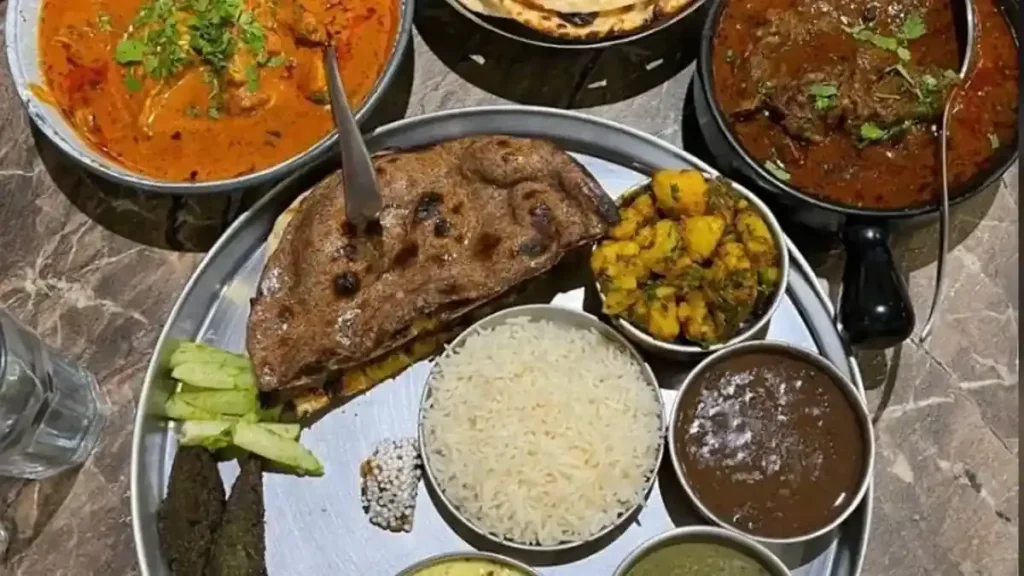
If you ask for a Kumaoni meal at a homestay, a typical plate might have:
- Bhatt ki churkani or gahat dal
- Aloo ke gutke
- A seasonal saag (kapa or sisunak)
- Kumaoni raita
- Bhang ki chutney
- Rice, and madua or wheat roti
- Jhangora kheer or a piece of bal mithai
It’s simple, filling and far better than what most tourist-town menus serve.
Where to eat Kumaoni food
At a homestay or villa with a cook. Home cooking is still where Kumaoni food is best. Most hosts need a few hours’ notice for traditional dishes, since several use soaked or roasted ingredients.
In Almora. For bal mithai and singori, go to Almora’s old sweet shops.
At dhabas on hill roads. Aloo ke gutke, raita and parathas are common. The full thali is rarer.
In the orchard towns. Ramgarh and Mukteshwar have roadside stalls selling fruit, jams and preserves in season. See things to do in Ramgarh and places to visit near Mukteshwar.
Planning a trip around the region? Our 4-day Kumaon itinerary builds in a food stop each day.
Kumaoni food at Saanjh Stays
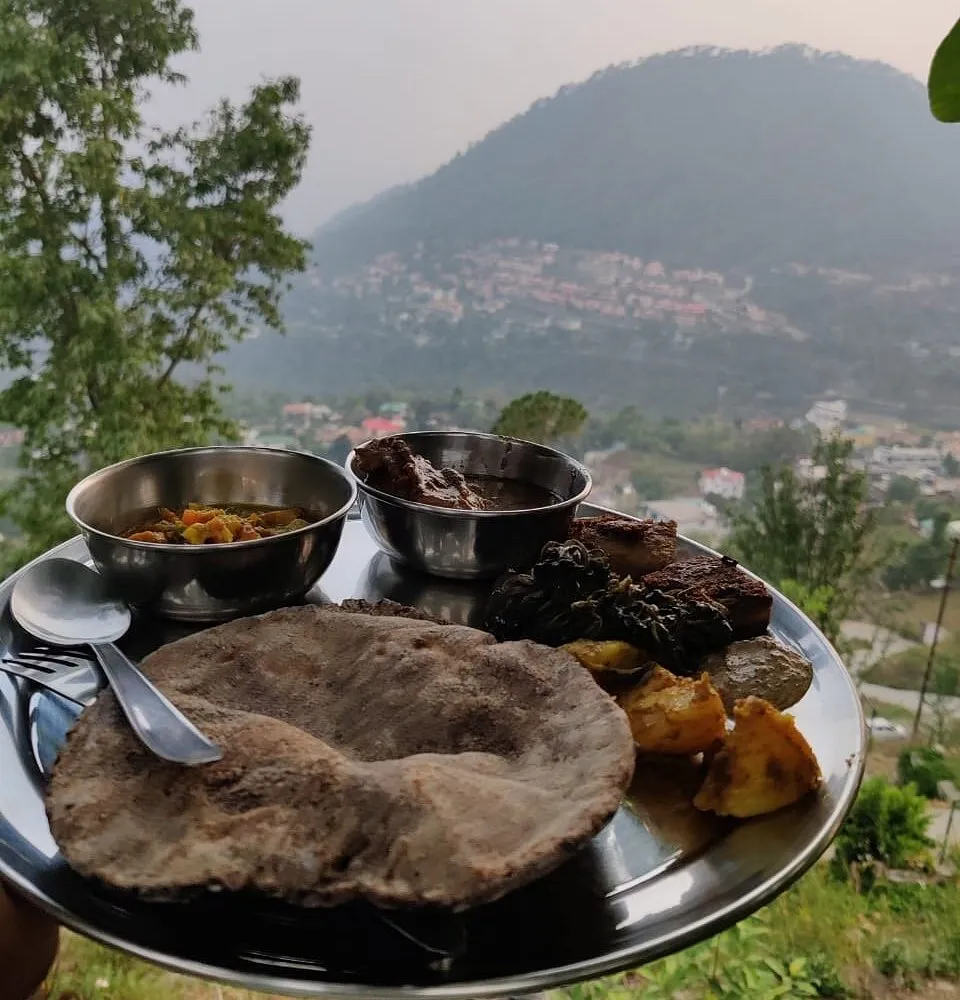
At our villas in Ramgarh (Sukoon, Vanyara) and Umagarh (Vaayu Villa), local Kumaoni meals can be arranged on request with a few hours’ notice. Nature Home in Mukteshwar serves home-cooked food. And if you’d rather cook, most of our villas have a working kitchen. Buy jakhiya and bhatt at the local market and try it yourself.
Taste it where it’s made: Kumaoni meals on request at Sukoon, Vanyara and Vayu Villa. See our group and pet-friendly villas in Ramgarh or book directly at saanjhstays.com.
FAQs
Bhatt ki churkani (a black soybean curry) and aloo ke gutke (spiced potatoes with jakhiya) are the most famous Kumaoni dishes. Among sweets, Almora’s bal mithai is the best known.
Jakhiya is a small wild mustard seed used for tempering in Kumaoni cooking. It crackles in hot oil and gives dishes a nutty, slightly bitter flavour.
Jakhiya is a small wild mustard seed used for tempering in Kumaoni cooking. It crackles in hot oil and gives dishes a nutty, slightly bitter flavour.
It’s made from roasted hemp seeds, which are not intoxicating. The chutney is a common everyday side dish in Kumaon.
Bal mithai comes from Almora, where its old sweet shops sell it fresh. It’s also available in Nainital, Haldwani and other Kumaon towns.
Kumaoni food is flavourful rather tan very spicy. The heat comes from red chilli, mustard seeds and jakhiya, and most dishes are milder than typical North Indian restaurant food.