


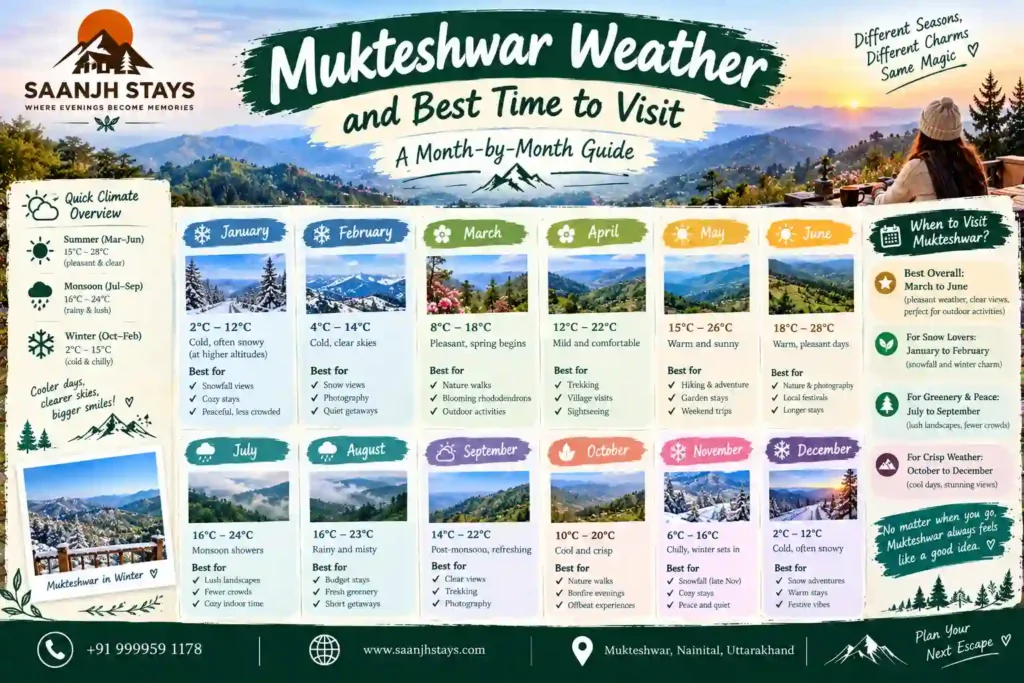
Quick answer of Mukteshwar Weather Best Time to Visit: The best time to visit Mukteshwar is October to November for clear Himalayan views and dry, crisp days, and March to June for mild weather and orchard blossom. December to February is cold, with average lows around 2 °C and a chance of snow. July to September brings most of the year’s rain (about 800 mm across the three months), with fog and occasional landslides.
Mukteshwar has a long-running India Meteorological Department (IMD) observatory, so the figures below are official 30-year averages, not guesses.
How high is Mukteshwar?
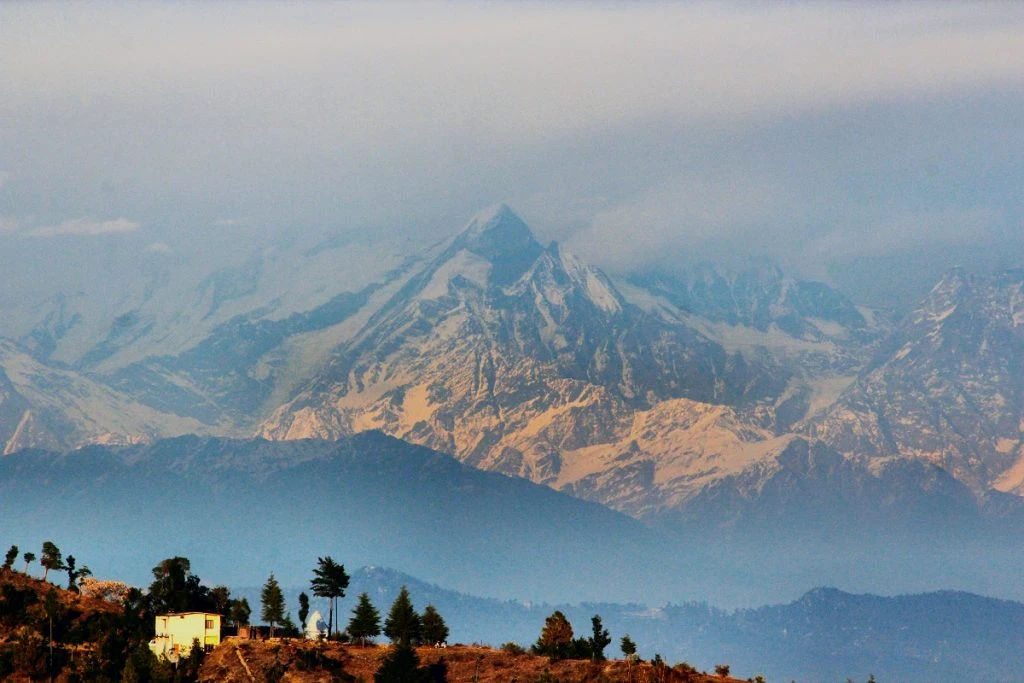
Mukteshwar sits on a ridge, so its height depends on where you stand. Wikipedia’s infobox gives the town’s elevation as 2,171 m (about 7,100 ft), while the temple ridge at the top is about 2,300 m (about 7,500 ft). Either way, it’s higher than Nainital (about 2,084 m), which is why Mukteshwar is usually a couple of degrees colder and noticeably windier.
Mukteshwar Weather Best Time weather by month
| Month | Avg. max / min (°C) | Avg. rainfall (mm) | What it’s like |
|---|---|---|---|
| January | 12.1 / 1.7 | 46 | Coldest month; frost; snow possible |
| February | 13.5 / 2.7 | 68 | Cold, bright; late snow possible |
| March | 17.9 / 5.8 | 47 | Spring; rhododendrons; cool nights |
| April | 22.4 / 9.7 | 46 | Warm, dry; orchards in blossom |
| May | 24.2 / 12.1 | 64 | Warmest month; pleasant |
| June | 23.7 / 13.8 | 159 | Pre-monsoon; rain from mid-month |
| July | 21.4 / 14.2 | 288 | Wettest month; fog, landslide risk |
| August | 20.9 / 13.9 | 283 | Heavy rain continues |
| September | 20.8 / 12.6 | 229 | Rain easing; very green |
| October | 19.7 / 9.3 | 30 | Clear skies; best views |
| November | 17.2 / 6.1 | 8 | Driest month; crisp and clear |
| December | 14.4 / 3.6 | 18 | Cold, dry, mostly clear |
| Year | 19.0 / 8.8 | 1,286 |
Source: India Meteorological Department climate normals for Mukteshwar, 1991–2020, as published on Wikipedia. For today’s weather, check the IMD website or a forecast app; these are long-term averages.
Two things stand out. Even the warmest month, May, averages only 24 °C by day, so Mukteshwar never gets hot. And November is almost dry, with about 8 mm of rain on average, which is why the views are so clear.
Spring: March to May
March starts cold, around 6 °C at night, but days reach 18 °C and the rhododendrons turn the slopes red. By April, the apple, peach and plum orchards around Mukteshwar and Ramgarh are in blossom.
May is the warmest month at about 24 °C by day and 12 °C at night. It’s comfortable for walking, the Bhalu Gaad waterfall hike and paragliding, but haze often hides the snow peaks.
Good for: families, walkers, and anyone escaping the heat on the plains.
Monsoon: June to September
The rain builds through June (about 159 mm) and peaks in July (288 mm) and August (283 mm). Fog rolls across the ridge, the forests are at their greenest, and the Himalayan view mostly disappears.
The practical issue is roads. Landslides can close the Bhowali–Ramgarh–Mukteshwar road for hours. If you go, keep a buffer day, start drives early, and check conditions each morning.
September is the turn: rainfall drops to about 229 mm, and by the end of the month clear mornings return.
Good for: writers, workations, and people who like mist and rain on the roof.
Autumn: October and November
This is the season we recommend most often.
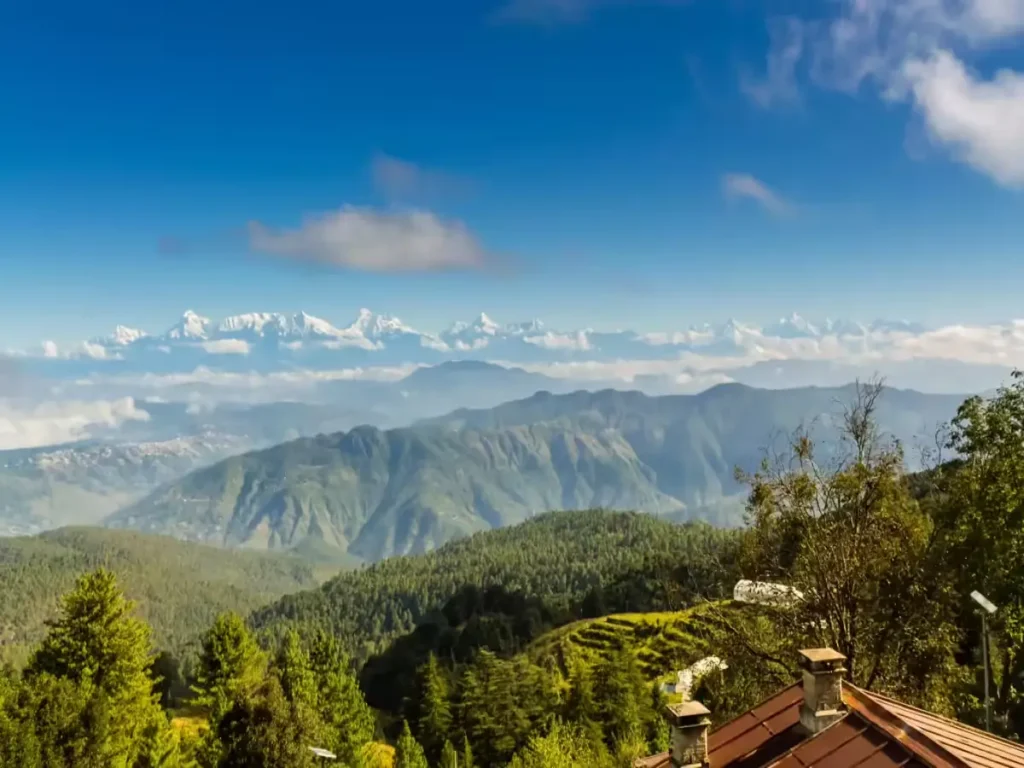
October averages about 20 °C by day and 9 °C at night, with only 30 mm of rain. The air is washed clean after the monsoon, and on many mornings the Nanda Devi, Trishul and Panchachuli ranges are sharp on the horizon, best seen from behind the Mukteshwar Dham temple at sunrise.
November is the driest month, about 8 mm, with days around 17 °C and nights near 6 °C. Crowds are thin outside the Diwali weekend.
Good for: photographers, couples, and anyone coming for the view.
Winter: December to February
December is cold and mostly dry: about 14 °C by day and 4 °C at night, with clear skies.
January is the coldest month, with average lows of 1.7 °C. Nights below freezing are common in cold spells. Snow is possible in January and February but isn’t guaranteed every year. We cover snow, roads and packing in our Mukteshwar in winter guide.
Good for: people who like cold nights, fires and clear stars, and who want a chance of snow.
The wind factor
The averages don’t show the wind. Mukteshwar’s ridge is exposed, and on winter afternoons the wind makes 10 °C feel much colder. Pack a windproof layer even if the forecast looks mild.
Weather and road safety
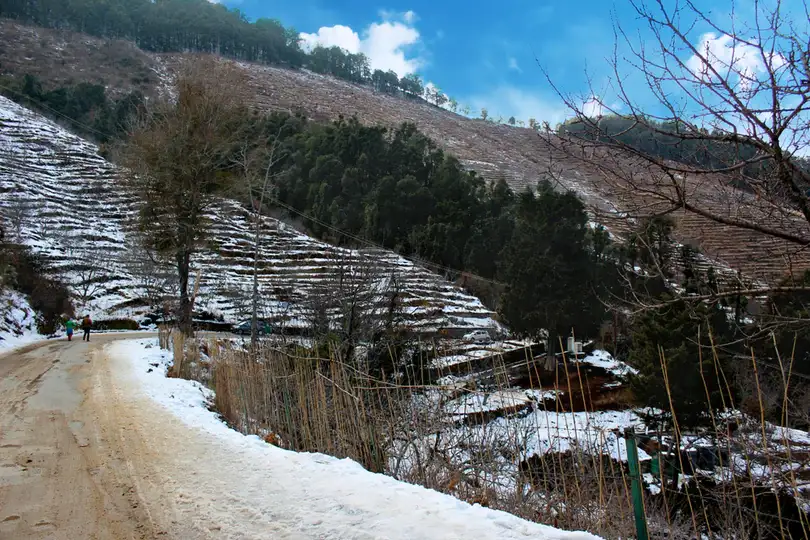
Weather affects the drive more than the stay. In the monsoon, check road status on the morning you travel and avoid the hill section after heavy overnight rain. In winter, avoid driving before about 10 am, when shaded bends past Ramgarh can still be icy, and plan to arrive before sunset. In both seasons, keep a buffer day if you have a train or flight to catch from Kathgodam or Pantnagar.
Best time to visit Mukteshwar for…
| If you want | Go in |
|---|---|
| Clear Himalayan views | October–November, and clear winter mornings |
| A chance of snow | January–February (not guaranteed) |
| Orchard blossom | April |
| Fruit season (peach, plum, apple) | June–August |
| Escaping the heat | April–June |
| Quiet and low prices | November, early March, monsoon weekdays |
| Adventure (paragliding, climbing) | October–June, dry days |
Mukteshwar vs Nainital weather
| Month | Mukteshwar (max / min °C) | Nainital (max / min °C) |
|---|---|---|
| January | 12.1 / 1.7 | 10.9 / 1.7 |
| May | 24.2 / 12.1 | 23.2 / 14.3 |
| July (rain) | 21.4 / 14.2 (288 mm) | 21.7 / 16.3 (685 mm) |
| October | 19.7 / 9.3 | 18.8 / 9.7 |
The two use different IMD periods (Mukteshwar 1991–2020, Nainital 1961–1979), so compare them loosely. The big difference is rain: Nainital’s lake basin gets far more monsoon rain on average than Mukteshwar’s ridge. What the table doesn’t show is wind, which makes Mukteshwar feel colder in winter.
The orchard and flower calendar
- March–April: rhododendrons (buransh) flower red on the slopes.
- April: apple, peach and plum blossom in the orchards around Mukteshwar and Ramgarh.
- June–August: fruit season. Peaches, plums and apricots come first, with apples later in the summer. Roadside stalls sell fruit straight from the growers.
- October–November: clear skies and autumn light on the terraced fields.
What to pack by season
- March–May: light jacket, sunscreen, walking shoes
- June–September: waterproof jacket, quick-dry clothes, shoes with grip, insect repellent
- October–November: fleece and a warm jacket for evenings
- December–February: thermals, heavy jacket, windproof layer, gloves, woollen cap, warm socks
Where to stay for each season
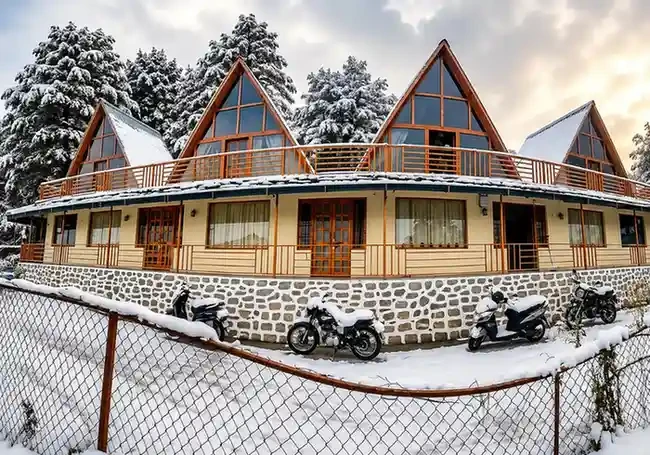
In winter, check that your stay has room heaters, hot water and power backup. In the monsoon, a place that serves food on site saves wet drives at night. Our Nature Home in Mukteshwar serves home-cooked meals and has Himalayan-view rooms (from ₹3,500 a night), which matter most in October and November. Compare options for a Mukteshwar homestay.
Still deciding whether Mukteshwar is right for you? Read is Mukteshwar worth visiting, and see places to visit near Mukteshwar once you’ve picked your dates. Comparing with Nainital? Our best time to visit Nainital uses the same month-by-month format.
How we put this together
The climate table uses IMD’s 1991–2020 normals for the Mukteshwar observatory, as published on Wikipedia. Altitude figures come from Wikipedia and published temple guides; they differ because the town spreads across a ridge. Season descriptions draw on that data and our experience hosting guests in Mukteshwar through the year.
Disclosure: Saanjh Stays runs Nature Home and A Cottage in Mukteshwar.
FAQs
October to November is the best time for clear Himalayan views and dry weather. March to June is best for mild days and orchard blossom. December to February suits those who want cold weather and a chance of snow.
Mukteshwar town is about 2,171 m (7,100 ft) above sea level, and the temple ridge reaches about 2,300 m (7,500 ft).
December averages about 14 °C by day and 4 °C at night, according to IMD data. January is colder, with average lows of 1.7 °C.
Snow is possible in January and February, but not every year. The higher temple ridge gets it first.
No. May is Mukteshwar’s warmest month, but it averages only about 24 °C by day and 12 °C at night.
It’s open, but July and August average about 285 mm of rain each, and landslides can close roads for hours. Travel with flexible dates and check road conditions daily.
October and November have the clearest views. November is the driest month, with about 8 mm of rain on average.
Yes, slightly. Mukteshwar is higher than Nainital and sits on an exposed ridge, so it’s usually a couple of degrees colder and windier.
Two to three days is enough for the temple, Chauli Ki Jali and nearby walks. Add a day for trips to Ramgarh, Peora or Jageshwar.
Wear thermals, a heavy jacket, a windproof outer layer, gloves, a woollen cap and warm socks. The wind on the ridge makes it feel colder than the temperature suggests.
Sources
- Wikipedia – Mukteshwar (IMD 1991–2020 climate normals, altitude)
- Tusk Travel – Mukteshwar temple guide (altitude of temple ridge)
- Wikipedia – Nainital (altitude, for comparison)
- Saanjh Stays – Nature Home
About the author
[Author name], [role] at Saanjh Stays. [One line on hosting guests in Mukteshwar across the seasons.] Saanjh Stays runs Nature Home and A Cottage in Mukteshwar, plus private villas in Ramgarh, Umagarh and Bhimtal.